
Store operations - 7 min read
By Laurynas - Updated
AOV vs LTV: How Shopify Stores Should Use Both Metrics
AOV and LTV answer different questions. Average order value shows how much a customer spends in one order. Customer lifetime value estimates the revenue or profit a customer brings over the whole relationship. Shopify stores need both: AOV helps improve the current cart, while LTV helps decide whether the customer and the growth strategy are worth keeping.
The useful decision is not to choose one metric over the other. Use AOV to test a specific shopping moment, then check LTV to see whether that change attracts better customers, brings them back, and protects the margin needed to serve them.
AOV and LTV measure different parts of the customer relationship
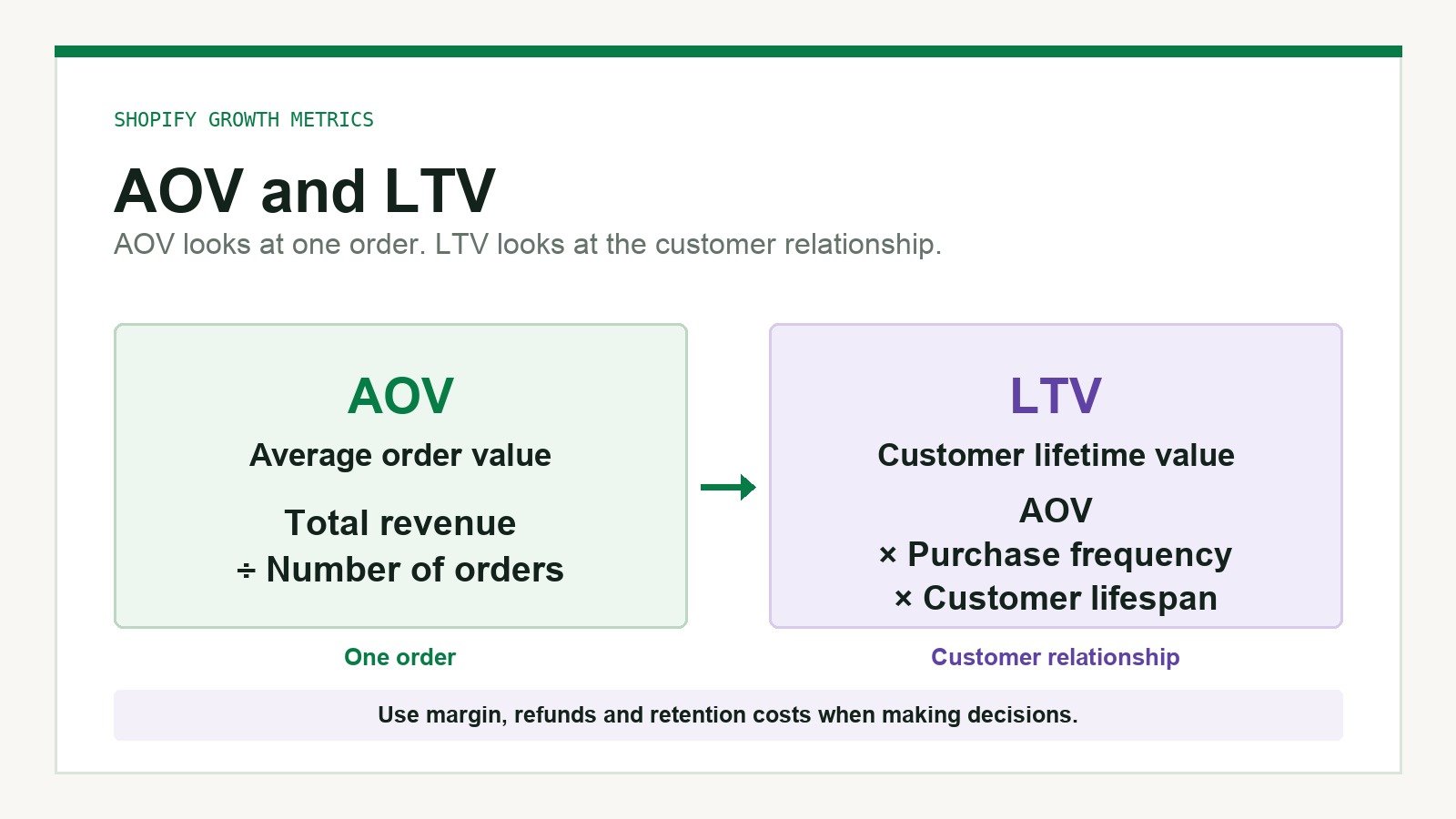
AOV is total revenue divided by the number of orders in the same period. If a store earns €50,000 from 2,500 orders, its AOV is €20. It is a fast way to see how basket size changes after a bundle, free-shipping threshold, volume offer, or product recommendation.
LTV is the expected value of a customer across repeat purchases. A simple revenue view multiplies average order value by purchase frequency and expected customer lifespan. A profit view should also account for gross margin, refunds, discounts, shipping subsidy, support, and retention costs. The exact formula can vary, but the purpose is consistent: identify which customers create durable value rather than a one-time sales spike.
Use AOV for the immediate cart decision
AOV is useful when you are changing something a shopper sees before checkout. It can reveal whether a free-shipping threshold encourages an extra item, whether a bundle is understood, or whether a cross-sell is relevant enough to add without slowing the purchase.
Do not read AOV alone as profit. A discount can lift basket value while cutting margin. A bundle can raise revenue while increasing fulfilment cost. Review gross profit per order, conversion rate, discount rate, and refund rate beside AOV before treating a test as a win.
- Use a clear comparison period and exclude cancelled or test orders consistently.
- Segment AOV by first-time and returning customers so repeat behaviour is not hidden.
- Compare the promotion cost with the additional gross profit, not revenue alone.
- Check whether higher-value carts still convert at a healthy rate.
Use LTV to decide where growth is sustainable
LTV is more helpful when a decision stretches beyond one order. It can guide how much you can spend to acquire a customer, which channels produce repeat buyers, and which products create a useful next purchase. It also helps expose a common problem: an acquisition campaign may look efficient on its first order but bring customers who do not return.
Start with cohorts rather than one store-wide average. Compare customers by first product, acquisition source, country, discount use, or first-order month. A cohort view makes it easier to see whether a higher AOV came from the customers you want more of or from an offer that only produced one-off bargain buyers.
The AOV-LTV trade-off to watch
A higher AOV is not automatically better LTV. For example, a large first-order discount may push a shopper over a free-shipping threshold and raise the first basket, but it can also train customers to wait for the next offer. A premium bundle may increase AOV and LTV when it helps the customer use the product successfully, but not when it adds items they do not need.
Ask one question before every upsell, bundle, or discount: does this make the current purchase more useful and improve the chance of a satisfactory next purchase? If the answer is no, the tactic may only move revenue forward or reduce margin.
A practical Shopify measurement routine
Choose one customer-facing change at a time. For example, test a product bundle on a collection with enough traffic. Record the baseline AOV, conversion rate, gross margin per order, and refund rate. Keep the test long enough to include normal weekday and weekend variation.
Then revisit the customers from that test after a defined repeat-purchase window. Compare their second-order rate, repeat AOV, and gross profit with a similar prior cohort. This turns AOV from a dashboard number into a decision about customer quality.
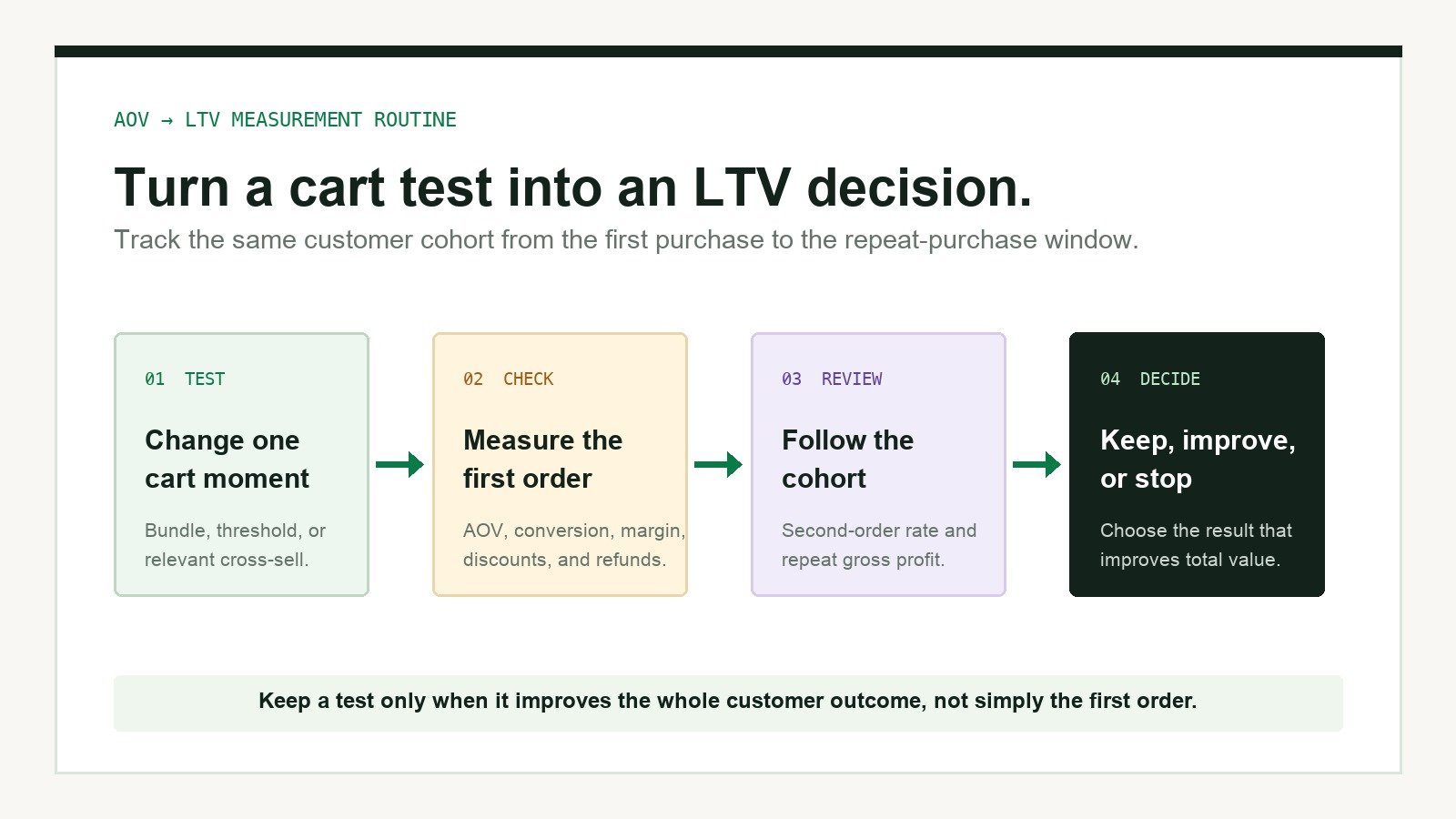
- Define the offer and the customer segment before changing the storefront.
- Record the baseline for AOV, conversion, discount use, margin, and refunds.
- Run one change, then stop or adjust it when the evidence is clear.
- Review the cohort after a repeat-purchase window that fits your category.
- Keep the change only when the total customer outcome is better, not simply the first order.
When to prioritise each metric
Prioritise AOV when you have healthy demand but thin order economics, shipping thresholds that are too easy to reach, or a clear complementary product that shoppers routinely buy later. Prioritise LTV when repeat purchase is low, service or product experience creates churn, or acquisition costs are rising faster than the value customers generate over time.
For most stores, the answer is sequence: make the first order useful, deliver it well, then earn the second order. AOV helps fund the relationship. LTV tells you whether the relationship was worth funding.
AOV and LTV questions
<strong>Should LTV use revenue or profit?</strong> Use revenue for a quick directional view, but use a margin-aware model for decisions about acquisition, discounts, and service investment. Revenue can overstate the value of customers who buy low-margin products or use expensive promotions.
<strong>Can a lower AOV still be a good result?</strong> Yes. A smaller first order can be healthy when it brings a customer who returns, uses fewer discounts, and costs less to support. Compare the full cohort outcome before changing the offer back.
<strong>How often should a Shopify store review LTV?</strong> Review it on a cadence that matches the normal repeat-purchase cycle. A coffee subscription can be checked more often than a furniture store. The important point is to use the same window when comparing cohorts.

Written by
Laurynas
- 7+ years with Shopify
- 15+ years in ecommerce
Laurynas has over 15 years of experience in ecommerce, including more than 7 years working with Shopify. He brings that background to his writing about Shopify tools and the everyday decisions involved in running an online store.